Capital Architects Program™
- For
- The managers and executives who will govern the system.
- What happens
- Architects learn to build the governance itself: the stages an opportunity advances through, who decides at each gate, how the portfolio is read across six capitals, the operating rules, and how funding is released as uncertainty falls.
- On completion
- Serious Capital Architect™.
In detail
Why the Program
Financial capital carries eight layers of governance: visibility, decision authority, accountability, cadence, impact assessment, incentive alignment, board-level reporting, and a structure that outlives its author. Human, intellectual, reputational, political, and social capital carry almost none. That imbalance is Capital Distortion, and the state it produces is Capital Asymmetry. Erosion begins in the five leading domains as Capital Snowmelt and cascades toward the financial line, which reports last. The Program builds the leaders who design the system that corrects it.
Who it is for
The leaders who set the system others operate inside: the chief operating officer, the transformation director, the head of strategy, and the vice presidents and directors who set the measurement and allocation logic the rest of the organization works under. Capital architecture spans business units, so the room is drawn from across the enterprise.
Five capabilities, all five, always
- Govern Capital Building Development: the stages an opportunity advances through, the evidence required at each gate, and the discipline that stops what has not earned its next stage.
- Govern Capital Building Decision-Making: who decides what, at which gate, on what evidence, with what personal consequence.
- Govern Capital Building Portfolios: reading allocation across all six capital domains, detecting drift, and rebalancing.
- Govern Capital Building Operating Principles: the rule set that governs the performance system and the growth system at once, with incentives that pay for multi-capital stewardship.
- Govern Capital Building Funding: releasing capital as uncertainty falls, and liberating it from what has stopped earning.
Funding and Operating Principles are the two most often dropped. The Program drops neither.
Six governance practices
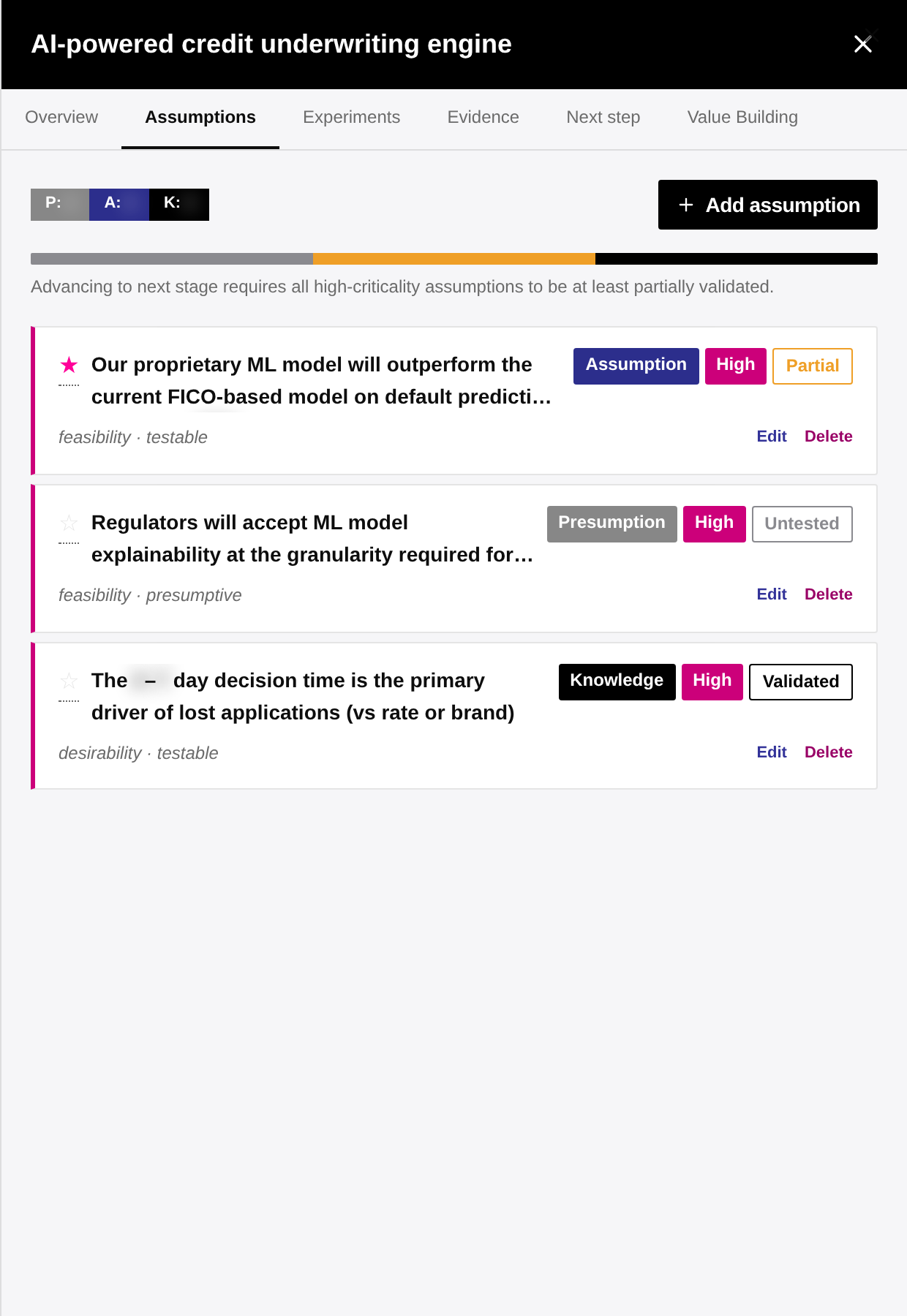
- Surface Assumptions: no opportunity passes a gate without the beliefs beneath it stated.
- Commit in Stages: capital is released as uncertainty falls, not all at once.
- Allow Reversal: stopping a committed move is legitimate, not a career event.
- Judge the Decision: a decision is judged on its evidence, separately from the person who made it.
- Count All Six: consequential decisions are assessed for their effect on all six capital domains.
- Watch Upstream: leading indicators are reviewed on their own cadence, before the financial line moves.
The standard
Each participant’s designed system is graded against seven principles: Domain Clarity, Visibility Infrastructure, Decision Authority, Accountability Structure, Governance Cadence, Cross-Domain Integration, and Continuity. Continuity is the one that fails quietly: a design that works only because a specific executive sponsors it has not satisfied it. Serious Capital Architect™ is earned against these principles, not conferred for attendance, and does not make an Architect a Certified Capital Activator™.
How it closes
Participants read where their own organization’s governance stands, its exposure and its capacity to operate what they have designed. Then the escalation question, verbatim:
“Of the assumptions we surfaced—which ones, if wrong, would change a capital allocation decision that only your CFO or CEO can authorize?”
Where the gap is measurement, the route is the Growth Gap Diagnostic™. Where it is operating capacity, the Capital Activator Intensive™.
Priced per participant, in-company, for five participants or more. Set in conversation. No discounts.
A conversation with Solve Next scopes it.
Start a conversation