Capital Snowmelt
The efficiency books now. The hollowing books later.
Most AI updates in board packs this quarter read well, and most of them are right. This Note is about what doesn’t appear: what an organization stops learning when a model does the first year of the work, and why that cost books years after the saving does.
What every call comes back to
Every call I take these days finds its way to the same three things:
- What AI is doing to executive attention.
- Where financial capital is flowing.
- The anxiety being felt at every level of the organization.
I hear it from advisors and from executives, across sectors, industries, and geographies.
The first two show up in the board pack. There is a slide on AI in most of them this quarter, and in a good number it reads well. A function delivering more with the same team. A hiring plan that grew more slowly than the work. A cost line that bent, in a few of them by a visible margin.
None of that is invented, and none of it is wrong. If you sit on a board, you have probably approved a version of that slide, and you were right to.
The anxiety is not on the slide. That gap is where this Note starts, because the cost of the gain the slide reports runs on a different clock.
Not a failure to convert
I have written about AI investment twice this year. Bonfires Don’t Heat Buildings, in April, and Capital goes in. Nothing comes out., in August, made the same argument from different evidence: most of the money is not converting into anything the business can measure.
That still largely holds. Yotzov, Bloom, and colleagues surveyed nearly 6,000 senior executives in the United States, the United Kingdom, Germany, and Australia. Their NBER working paper came out in February. Across the four surveys, 89% of firms reported no impact from AI on labor productivity over the previous three years.
This Note is about the other cases—the ones where AI does convert, and the conversion runs the wrong way across time.
Where the quarter is being improved
If productivity has mostly not moved, the gain on that slide is coming from somewhere else. Stanford’s Digital Economy Lab offers a place to look.
Brynjolfsson, Chandar, and Chen’s Canaries in the Coal Mine?, updated in August, finds employment among 22- to 25-year-olds in highly AI-exposed occupations about 19% below where it would be had it kept pace with similarly aged workers in less-exposed ones. A year earlier the gap was 15%. Two qualifications matter. It is a shortfall against a counterfactual, not a count of jobs cut. And it runs mainly through hiring that did not happen rather than through people let go.
The second qualification is the one a board should hold onto.
A layoff leaves a severance line. A hire not made leaves nothing on any statement at all.
What the missing cohort would have learned
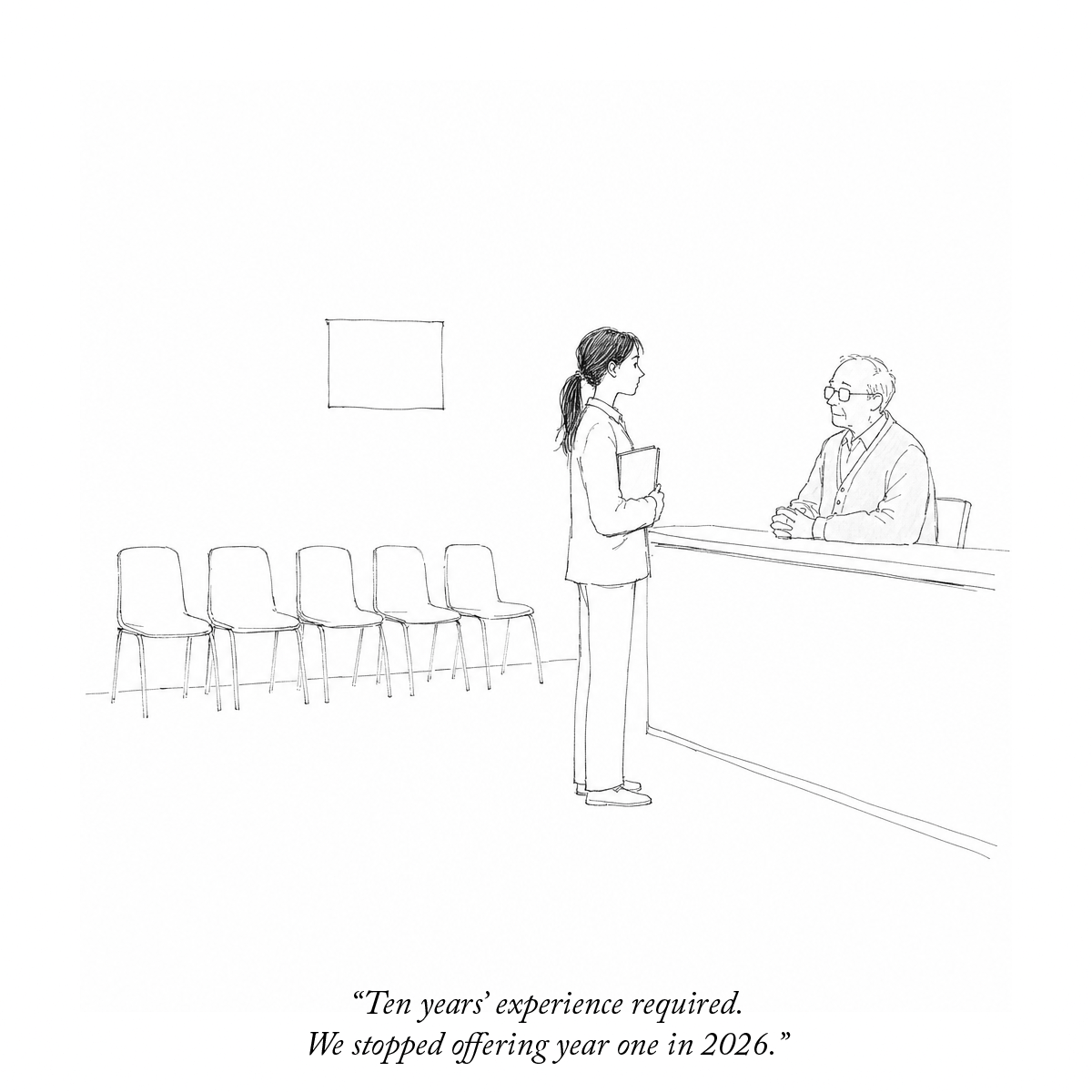
The entry-level years are where an organization builds its future judgment. People learn the business by doing the first, unglamorous version of the work. The draft. The reconciliation. The first-pass analysis. And having it corrected. That is the work a model now does well.
So the hire not made is more than a cost avoided. It is a senior person in 2032 who will not be there, and a body of working knowledge that will not form, because nobody did the work that forms it.
The people already in the building carry a version of the same risk. Lee and colleagues at Microsoft Research and Carnegie Mellon surveyed 319 knowledge workers for CHI 2025 and found that higher confidence in generative AI was associated with less critical thinking. Gerlich, in Societies (2025), found frequent AI use correlated with weaker critical thinking among 666 participants in the UK, mediated by offloading the thinking to the tool, and found younger participants the most dependent. Both studies are surveys, and neither establishes cause. Two different surveys, two different research groups, and the same pattern.
In Your first draft got better. So did everyone else’s, I argued that AI makes everyone’s output look alike. This is a different claim, about the capability of the people producing it.
Two entries, two clocks
The efficiency books in the quarter it happens. The hollowing books years later: a bench that is thin when a crisis needs it, and decisions made by people who never learned to check what the AI hands them.
The two entries never meet on one statement. By the time the hollowing arrives, the efficiency has been reported, rewarded, and absorbed into the baseline everyone is measured against.
This is Capital Snowmelt—erosion in the diffuse capital domains while financial performance holds or improves. An enterprise spends six domains: financial, human, intellectual, reputational, political, and social. Only the first has a statement. What sets the AI case apart from ordinary Snowmelt is that the erosion is producing the financial improvement as well as hiding behind it.
In the framework we work from, the cost reaches the financial line last, often years after the erosion began. The allocation decision behind it is visible today. It is in the headcount plan the board just approved.
The board keeps the longer clock
Management is paid on the clock the efficiency runs on. The board is the one body in the enterprise whose horizon is meant to outlast it.
Some of the anxiety I hear on those calls is people sensing the second entry before any report shows it.
Reading the second entry before it arrives—across all six domains, not only the one with a statement—is the work of Capital Symmetry Governance™. That work is larger than one Note, but one Note can ask three questions.
Take the last headcount plan your board approved.
- Which roles in it went unfilled because a model now does the first year of that work?
- In 2031, who will know what those people would have learned?
- Where, on anything that reaches this board, would you see the answer while it can still change?
The third question produces the finding. If the answer is nowhere, the saving has a line and the capability it cost has none. The board cannot govern what carries no line.
— Greg