Capital Cascade
The loop gets a name.
In April, in “When Governance Vacuums Fill With Ego,” I described Kodak’s decline as a cascade that sealed itself: ego turned a blind spot into a defense the company could not correct from the inside. In May, in “Why companies fail at liberation. Not creation.” Boeing was one of four companies whose binding constraint was release, not creation. This Note puts those two together. Boeing held on to its commitment and cut the thing that maintained it. From this Note through February, the Notes name the loops.
In April, in “When Governance Vacuums Fill With Ego,” I described Kodak’s decline as a cascade that sealed itself: ego turned a blind spot into a defense the company could not correct from the inside. In May, in “Why companies fail at liberation. Not creation.” Boeing was one of four companies whose binding constraint was release, not creation.
This Note puts those two together. Boeing held on to its commitment and cut the thing that maintained it. From this Note through February, the Notes name the loops.
Every enterprise in decline goes through a Capital Cascade. Erosion starts in a domain nobody reports on, moves from domain to domain, and arrives on the financial statements years later. Most cascades can be interrupted, because the erosion has not yet changed how the enterprise responds to it. Some cannot. In those, the response to the pressure feeds the erosion that produced the pressure. Those cascades are recursive, and the Recursion Typology names the mechanisms that make them so.
The first is the one that looks most like good management. I call it the Discipline Trap.
The pressure arrived as a financial signal
In 2011, Airbus’s A320neo offered airlines a fuel-efficient narrow-body that Boeing’s 737 could not match. Boeing chose to re-engine the 737 rather than design a new aircraft. That was an allocation decision, made on financial logic, and the logic was sound.
What followed was a sequence of savings. Each is in the record of the House Committee on Transportation and Infrastructure’s final report on the 737 MAX (2020).
- December 2011. Boeing’s contract with Southwest Airlines, the launch customer, required a discount of at least $1 million on every MAX delivered if the FAA required simulator training for pilots moving from the previous 737.
- Boeing cut 2,000 hours of avionics regression testing to lower costs.
- Management turned down an engineer’s request for a synthetic airspeed indicator, citing cost and the goal of avoiding simulator training.
- Throughout. Program leaders kept a countdown clock in their conference room.
Not one of these is reckless on its own. Each is the kind of decision a well-run program makes every week: hold the schedule, protect the business case, keep the customer’s economics intact. In a quarterly review, every one of them reads as discipline.
What the savings were made of
Look at what each saving was drawn from.
The 2,000 hours of testing were intellectual capital: the work that turns an assumption into something the organization actually knows. The synthetic airspeed indicator was the same capital in hardware. The simulator clause was subtler. It put a price, $1 million an airplane, on any finding that would require pilots to be trained on what the aircraft had become.
And the room for an engineer to say “this is not ready” is human capital. In November 2012, a Boeing test pilot in a simulator took more than ten seconds to respond when MCAS, the new flight-control software, activated on its own. The pilot called the result catastrophic. FAA guidance assumes a pilot responds within four. The committee found no evidence the finding was shared with the FAA, customers, or pilots. In a 2016 internal Boeing survey of the employees authorized to act on the FAA’s behalf, 39% of those who responded reported feeling undue pressure, and 29% were concerned about consequences if they reported it.
The savings were drawn from the domains a re-engined airframe needed most.
A modified airframe carrying bigger engines needed more testing, more interrogation of its assumptions, and more room for dissent, not less. The savings came from exactly there.
Why the loop tightens
Here is the mechanism, stripped of the aircraft.
Financial pressure arrives. The enterprise responds with cuts framed as discipline. The cuts fall on the practices that maintain the diffuse domains, because those practices look discretionary: specialist time, testing, training, documentation, the slack that lets someone raise a concern. Removing them makes the work harder and riskier, which shows up as schedule and cost pressure, which produces the next round of cuts. The pressure that started the loop is now being generated by the loop.
The governance system cannot see this, because it reads one of the six capital domains clearly. An enterprise runs on financial, human, intellectual, reputational, political, and social capital. Each cut improves the financial line, and the other five carry the cost where nothing totals it. At Boeing the political domain ran down alongside: the authorized representatives were Boeing employees working on the regulator’s behalf, and they were reporting pressure.
Each cut improves the one line the board reads. The cost lands in the five it doesn’t.
From inside, nobody sees the recursion. The financial results confirm the discipline, and the discipline deepens the erosion. The discipline had already cut the testing that would have shown the erosion.
At Boeing the loop ran for seven years. Lion Air Flight 610 crashed in October 2018. Ethiopian Airlines Flight 302 crashed in March 2019. Together they killed 346 people. The FAA grounded the MAX on 13 March 2019 and lifted the order twenty months later. In January 2021, Boeing entered a deferred prosecution agreement with the Department of Justice and paid more than $2.5 billion.
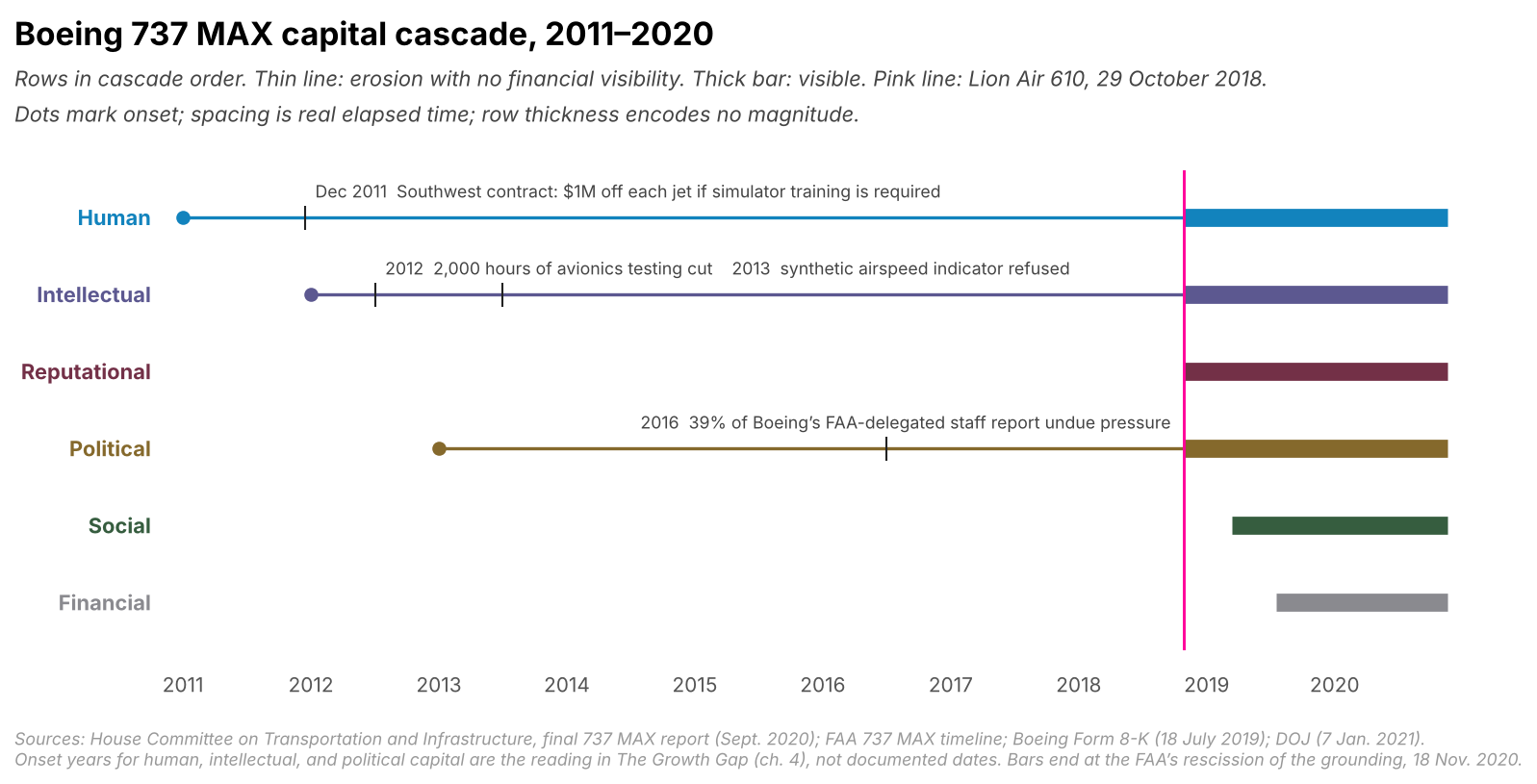 The Boeing cascade figure: seven years of erosion across the domains, then the financial bar about nine months later, when Boeing took a $4.9 billion charge against earnings.
Seven years of erosion no financial statement showed, then nine months from the first crash to Boeing’s first charge against earnings: $4.9 billion, in July 2019.
Nobody at Boeing decided to trade engineering judgment for schedule. The architecture made the trade, one defensible decision at a time.
The practices being cut are maintenance
Cutting is not the error. Calling the practices that maintain the five unreported domains discretionary is. Testing, specialist time, training, documentation, and the conditions for dissent are required maintenance. A reduction to any of them deserves the same review a new commitment of capital would get, because it is one.
Reading what each cut draws down across all six domains, before it is made, is the work of Capital Symmetry Governance™. One Note can give you the test.
What is being cut in the name of discipline that is actually being decayed?
Take every cost reduction your organization has approved in the last four quarters under the heading of efficiency, focus, or discipline. Ask four questions of each.
- Has specialist, engineering, or craft time been reclassified as overhead?
- Has pay for technical roles fallen behind pay for business-unit roles?
- Has training, testing, or simulation been trimmed as an efficiency?
- Has documentation thinned without anyone reviewing the decision?
Any yes, then one more: did that cut go through the review a new capital commitment would have to pass?
A yes to any of the four and a no to the last: that is the Discipline Trap, at the stage where it can still be interrupted. The financial result of the cut will look like evidence that it worked. Read it as the first turn of the loop.
— Greg