Capital Asymmetry
Capital goes in. Nothing comes out.
Gallup’s engagement report is being read as a document about morale. Read beside the AI investment figures it cites, it is a document about whether an enterprise can still convert the capital it deploys.
Last week, a reader tagged me under the new Gallup report and called it erosion of capital. “Greg,” he wrote, “as you’ve been saying.” He meant it as agreement, and he was right. But I have been sitting with the report since, because I think it is being read as the wrong kind of document—and the misreading is the whole point.
What everyone is reading it as
The headline number is that global employee engagement has fallen to 20%, down from a peak of 23% in 2022, its lowest level since 2020. The story wrote itself.
Workers are checked out, managers are burning out, the workplace is fraying. Gallup (2026) even put a price on it—roughly $10 trillion in lost productivity, or 9% of global GDP.
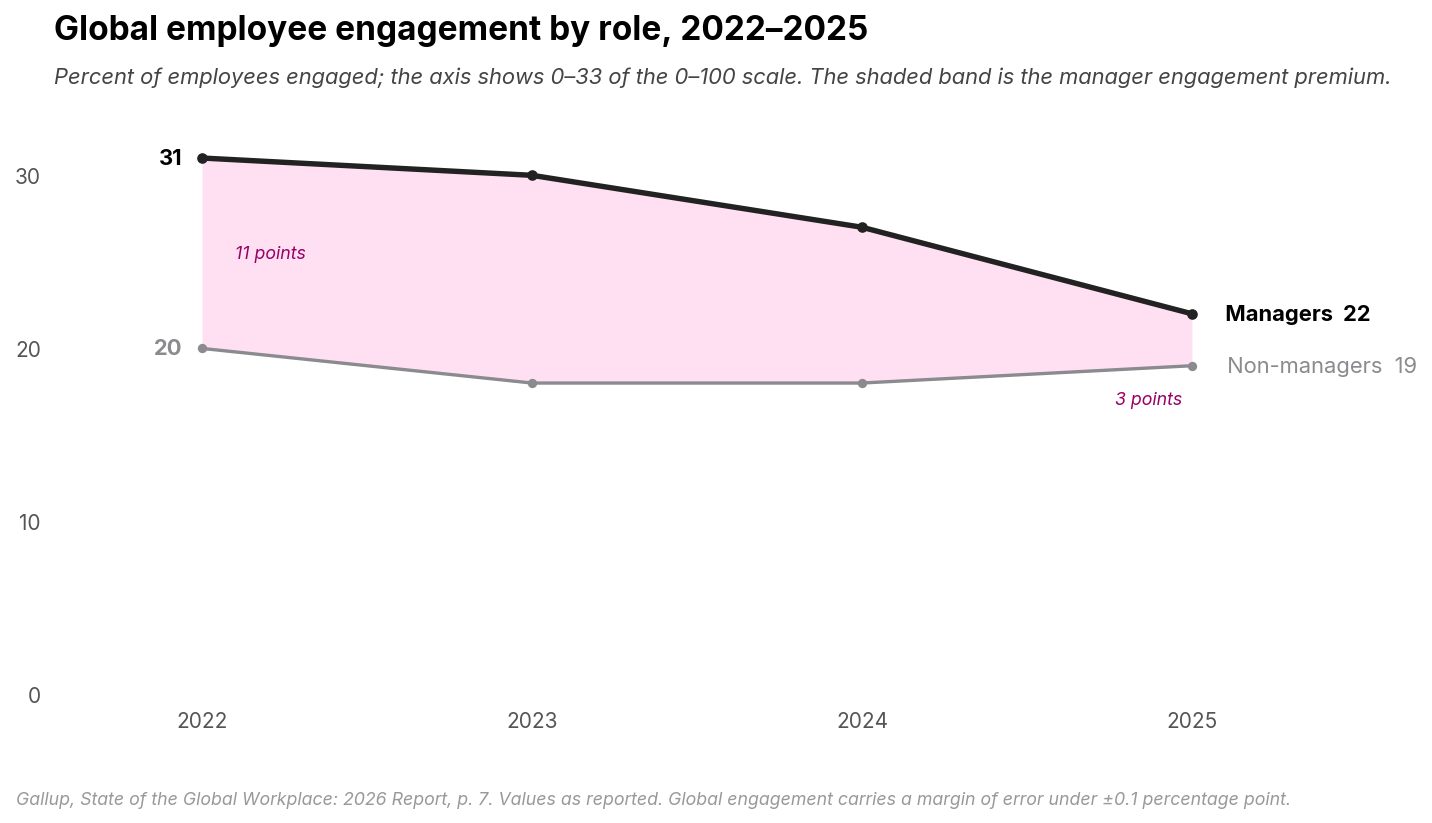
And the report names a culprit, and names it well: the manager. The engagement premium that used to come with running a team is gone. Managers are now barely more engaged than the people they lead.
All true. And all of it, I think, filed under the wrong account.
The document underneath the document
Because sitting a few pages earlier, in Gallup’s own opening letter, is a second number that nobody put next to the first. MIT Project NANDA’s 2025 study of enterprise AI found that despite roughly $40 billion in investment, 95% of organizations had seen zero measurable impact on profit. An NBER survey of nearly 6,000 executives, published this year, reports the same failure from the other side: 89% see no effect on labor productivity. The technology works. The money moved. Nothing came out the other end.
Two findings, two ends of one machine. At one end, capital goes in—financial, counted to the dollar, deployed at scale into tools that do what they promise. At the other end, nothing. And in between sits the layer everyone described as the cause: the managers.
They are not the cause in this story. They are the conversion mechanism.
The layer that turns money into anything
Human capital is the only capital that converts the others. Financial capital cannot deploy itself. A language model cannot adopt itself. Someone has to turn money and tools into the thing an organization actually runs on—the knowledge of how the work is done here, the trust of the customer who stays, the judgment that catches the mistake before it ships. That someone is, overwhelmingly, the manager.
Gallup’s own data says it plainly: in organizations investing in AI, the strongest predictor of employee adoption, aside from technical integration, is whether the direct manager actively champions it. Where employees strongly agree their manager supports the team’s use of it, they are 8.7 times more likely to say the technology has changed how the work gets done.
So watch what the report is actually describing. The layer that turns financial capital into intellectual and reputational capital has lost nine points of engagement in three years, from 31% to 22%. And at the far end of the machine, $40 billion converts into nothing. These are not two problems. They are the same erosion, read from opposite ends.
When human capital thins at the conversion layer, intellectual capital goes with it—the know-how walks out, the tacit judgment stops being passed down—and reputational exposure arrives a few quarters later, when the thing that used to get caught isn’t. The engagement survey is simply the earliest place it becomes visible.
Why nobody moves on $10 trillion
Which raises a big question. $10 trillion. Nine percent of global GDP.
Why does a number that large move no one to act structurally?
Because of what gets measured and what does not. The financial capital going in is counted to the decimal every quarter by people whose entire job is to count it. The human capital that converts it is measured once a year, softly, in a survey, and filed under HR. Of the six capitals that decide whether an enterprise endures—financial, human, intellectual, reputational, political, and social—one sits on the balance sheet the enterprise was built around. The other five do not appear on it at all.
That is Capital Asymmetry, and it runs for years before it reaches the only scoreboard anyone treats as real—the financial one—by which point it no longer looks like a people problem. It looks like a bad quarter. A market shift. An execution miss.
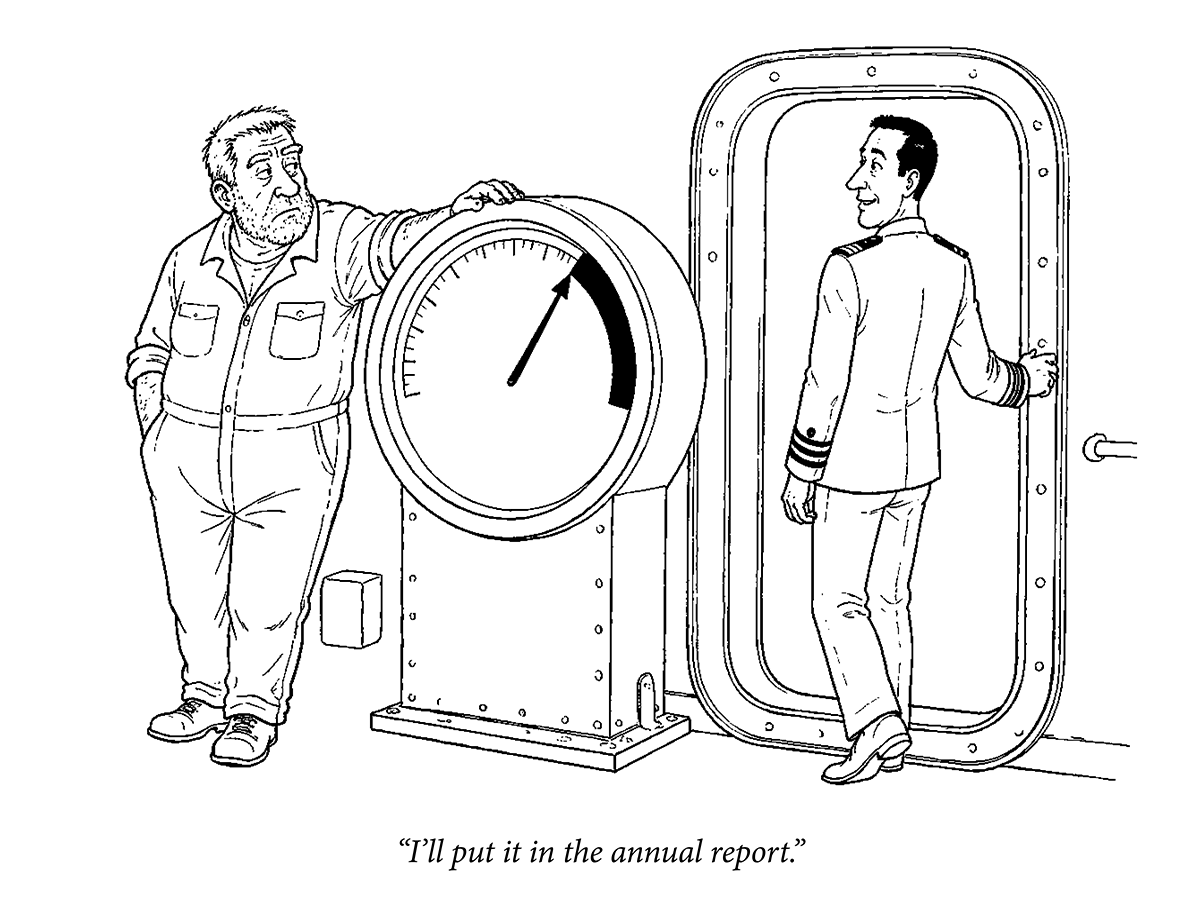
The engagement number is not a wellbeing metric. It is a lagging instrument pointed at a capital accounting cannot see. And it is blinking.
What to do with a blinking instrument
Here is the one thing I would change. The next time that number lands on your desk, do not send it to HR. Read it as a meaningful capital signal. Ask a different question of it—not “How do our people feel?” Rather, “What is this telling me about our ability to convert the money we are about to deploy?” Then look at the layer Gallup pointed to. If your managers are only as engaged as the people they manage, you do not have a morale problem. You have a conversion problem, and every dollar you are about to spend on tools, acquisitions, or change will meet it on the way through. Governing the six together rather than the one—Capital Symmetry Governance™—is what keeps a reading like this from arriving too late to act on.
The gauge that reads last
I return to the phrase my reader used: “Erosion of capital.” He was more right than the report he was praising. What Gallup measured is not that people are unhappy. It is that the machine is quietly losing the layer that runs it—and the only gauge anyone trusted to tell them was the one gauge that reads last.